


Blue Zones in Sardinia: Arzachena and the New Frontier of Longevity
Professor Giovanni Mario Pes, one of the scholars who identified Sardinia’s Blue Zone, talks to us about his research on the northeastern coast of Sardinia
The Blue Zones are five “paradises on Earth” around the world where, thanks to a delicate balance of factors, people live longer and healthier lives. They are Ikaria in Greece, Linda Loma in California, Okinawa (Japan), Nicoya in Costa Rica, and Ogliastra. In Sardinia, the name Giovanni Mario Pes is well known and associated with the discovery of the first Blue Zone, identified together with Michel Poulain in the mountainous areas of the island’s central-eastern region—specifically, the Ogliastra area. More than twenty years later, the picture may have changed: Arzachena, along with Porto Cervo and part of Sardinia’s northeastern coast, shows signs of longevity that deserve attention. The key distinction is between popular recognition and scientific validation: the public announcement in 2025 took place, but the study is still ongoing, and the data should be interpreted with caution, especially in a municipality marked by significant migration flows. The most compelling hypothesis is that certain generations born in rural Gallura have retained protective factors from traditional life, subsequently benefiting from the economic, health, and housing improvements that have taken place from the 1960s onward.
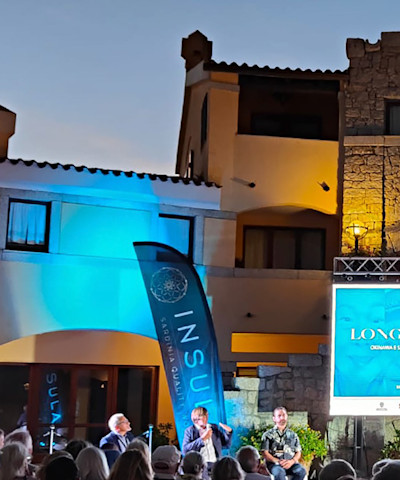
We asked Professor Pes—who will speak alongside Professor Alessandro Luciani on the first day of the Longevity Fest, presenting the latest data from a collaborative study with the University of Zurich—some questions about longevity research in Gallura.
 Giovanni Mario Pes
Professor Pes, do the inland areas of Sardinia—particularly Ogliastra and Barbagia—still hold a world record for longevity?
Generally speaking, yes. Demographic data show that just over a dozen municipalities in the mountainous Gennargentu region remain among the world’s leaders in longevity and can be compared to other areas of the globe known for their high concentration of centenarians, such as Okinawa in Japan, the Nicoya Peninsula in Costa Rica, and the Greek island of Ikaria. These areas came to be called “Blue Zones,” but the name arose almost by chance: over twenty-five years ago, I was marking the municipalities with high longevity on a map with a blue marker. Scientifically speaking, however, a Blue Zone is not a folkloric label: it is a small, relatively homogeneous area with exceptional longevity that must be verified using accurate demographic methods.
So does Sardinian longevity still apply only to mountain populations?
I wouldn’t say so. For decades, the largest number of centenarians was concentrated mainly in the communities of inland Ogliastra, but today the geography of longevity seems less static than we thought. In recent years, interesting signs have also emerged in Gallura, particularly in Arzachena. In the fall of 2025, we launched a systematic study of the municipality’s native population, and the initial results indicate a longevity rate higher than the regional average. I want to emphasize this: we’re talking about preliminary data, not yet definitive. However, the phenomenon appears real enough to warrant a thorough investigation. An initial public announcement was made a year ago during the Longevity Fest 2025; while there has been recognition at the public and institutional levels, scientific validation still requires further work. What have you observed?Local administrative data and press articles had already been pointing for some time to the consistent presence of centenarians in Arzachena and other municipalities in Gallura.What piqued my curiosity, however, was above all a historical detail: the civil registry office had informed me of a centenarian who had died in Arzachena at the age of 102 as far back as 1903—an extremely rare event in an era when life expectancy was still very low. This sparked the idea of systematically reconstructing the survival rates of the cohorts born in Arzachena between 1900 and 1925. In the dataset reconstructed so far, we have identified 45 centenarians out of 2,770 births: approximately one centenarian for every 62 births, a rate significantly higher than that of the entire island. I repeat, these are preliminary results from the ongoing study, which will need to be consolidated and compared with the indicators used for the historical Blue Zone.
So, can part of Gallura be considered a Blue Zone in every sense, or is it a demographic anomaly?
I don’t think so. The difference compared to the traditional Blue Zone is too small to be considered a mere coincidence. Of course, when studying extreme ages, the absolute numbers remain low, and we must avoid jumping to conclusions. However, the concentration of centenarians observed in Arzachena and other municipalities suggests the existence of a real phenomenon. In other words: we are not dealing with a mere statistical curiosity, but with a sign that deserves to be studied using the same rigorous tools employed for previously validated longevity zones. This is also because the very concept of a Blue Zone originated as a demographic concept, not a media one: before discussing causes, we must thoroughly verify the existence of the phenomenon. What, then, is the most interesting question raised by Arzachena?The question is this: how can a coastal area, profoundly transformed by international tourism and the growth of the service sector, produce levels of longevity that approach those of the agrarian-pastoral villages in the interior? It is an important question, because it forces us to move beyond an overly simplistic interpretation of Sardinian longevity. The case of Arzachena suggests that modernization and longevity are not necessarily at odds with one another. If economic development improves income, housing, access to healthcare, services, and mobility—but does not entirely erase family networks, dietary habits, and the relationship with the local territory—then a favorable combination can emerge. This, in my view, is precisely the most interesting hypothesis to test. After all, comparative studies on the Blue Zones have already shown that population longevity often stems from a delicate balance between a traditional lifestyle and the benefits of modernity.
And what role does diet play in this context?
Diet remains important, but it shouldn’t be imbued with almost magical powers. Studies on inland Sardinia have shown that diet alone is not enough to explain regional differences in longevity; occupational physical activity and the geographical characteristics of the area, on the other hand, appear to be highly significant. For Arzachena, I would make a similar argument: rather than imagining a diet that is suddenly “immune” to change, we must consider that the generations living long lives today had already formed their own tastes and eating habits before the boom in tourism and contemporary consumerism. In this sense, the Arzachena case might be less a failure to transition in dietary habits and more the effect of a transition that occurred late, among generations who had already internalized different habits. Here, too, however, we must speak of hypotheses rather than definitive proof.
Besides diet, what other factors might have contributed to this longevity?
Longevity never depends on a single cause. The generations that today reach or exceed 100 years of age grew up in a rural society, where physical activity was part of daily life and family and community ties were very strong. Later, these same people were able to benefit from improvements in economic conditions, housing, transportation, and health care. A favorable combination may therefore have emerged: retaining certain protective elements of traditional life while simultaneously reducing poverty, food insecurity, and difficulties in accessing health care services.
Could the environment also have played a role?
It’s an interesting hypothesis, but it has yet to be verified. The low building density in many areas, the presence of natural spaces, the opportunity to spend time outdoors, and limited industrialization may have contributed to quality of life. However, it would be incorrect to automatically attribute an effect on longevity to proximity to the sea. We would need to analyze exposure to pollution, housing conditions, occupations, and the movements of each individual over the course of their life.
What, then, will be the next steps in the research?
We will need to reconstruct the family and residential histories of the centenarians, break down the data by gender and generation, and compare municipalities in Gallura that share similar characteristics. It will be important to understand whether longevity is concentrated in certain families and to what extent diet, work, physical activity, economic conditions, and social networks have played a role. Only then will we know whether we are dealing with a new manifestation of Sardinian longevity and what characteristics distinguish it from the historic Gennargentu Blue Zone.
What lessons might the study of this new Blue Zone offer us, should it be verified?
Perhaps that modernization and longevity are not necessarily at odds with one another. Development can become an asset when it improves material well-being without erasing social ties, dietary habits, and the connection to the local area. This is, for now, the most compelling hypothesis that the Arzachena study invites us to explore.